Paste a link
An article, a podcast, a YouTube talk, a PDF. It becomes an item with its text already in it, so there is something to point at.
A reader with no algorithm
Everything else decides what is in front of you. Marker does not. You paste a link, or an agent does, and that is the entire ingestion story.
Free, and roughly a kilobyte an item. The web app runs anywhere; the native apps are in private beta.
How it works
There is one door, and you are the one who opens it. No recommendations, no discovery tab, no notifications. Nothing arrives that somebody did not choose.
An article, a podcast, a YouTube talk, a PDF. It becomes an item with its text already in it, so there is something to point at.
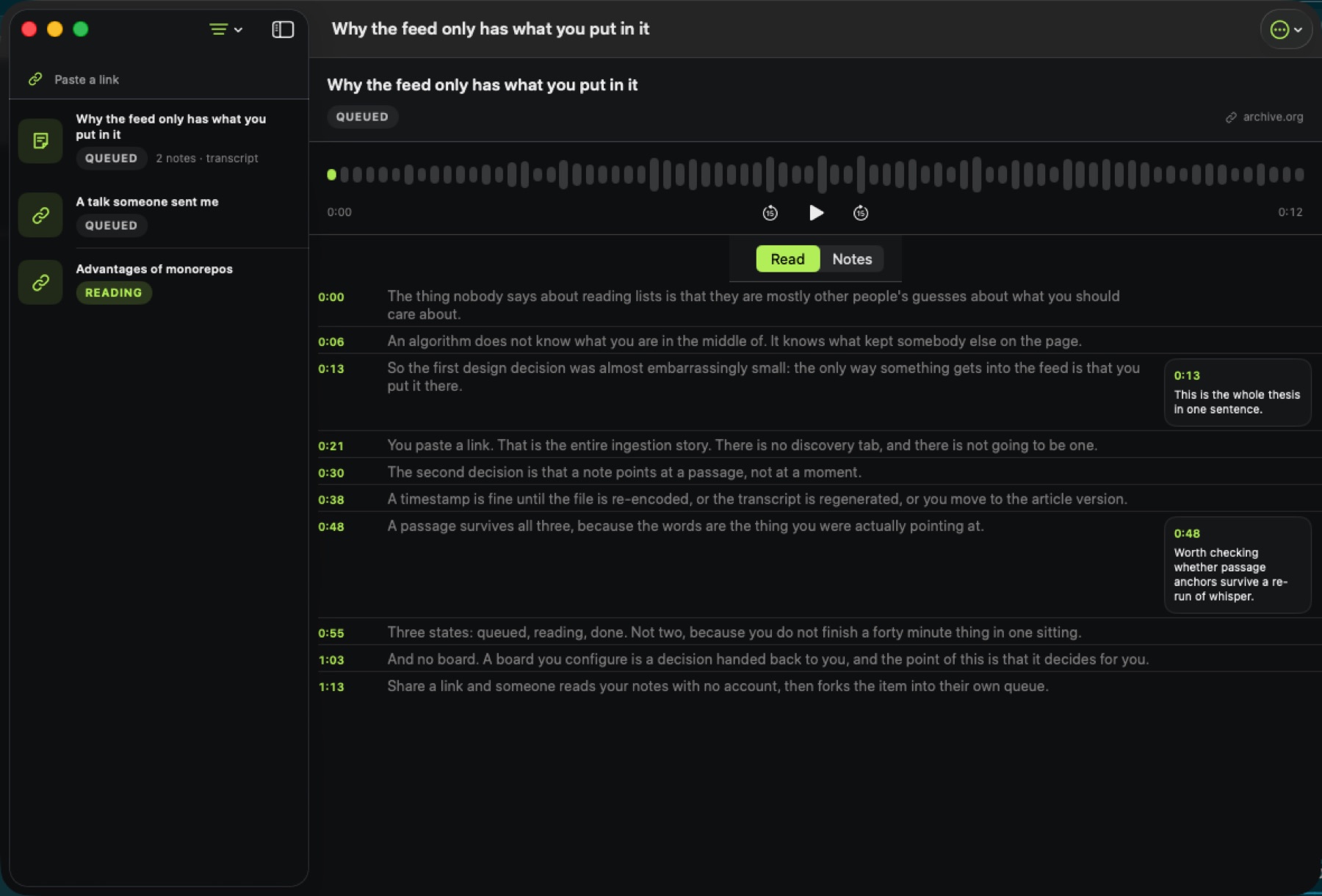
Select the words and say what you thought. The note lands in the margin beside them, and carries the timestamp too when there is one.
Private by default. Publish one item and anyone can read your notes with no account, then fork it into their own queue.
Three states, and no board
So there is no board. Three states, one list, and a sort control. Three and not two, because you do not finish a forty-minute thing in one sitting, and a queue that cannot show you what you are part-way through has failed at its only job.
Your state is private. Only the item you deliberately share is public.
The anchor
A timestamp is fine until the file is re-encoded, or the transcript is regenerated, or you move to the article version. A passage survives all three, because the words are the thing you were actually pointing at.
Audio, video, YouTube, articles and PDFs all become text you can point at. When the content has a timeline, the note carries that too, and clicking it plays from there.
And when extraction fails, the note degrades rather than disappearing: a bare timestamp, a page number, or an untimed note on the item. Whatever is there gets rendered, and never an empty affordance.
Four surfaces, one server
The web app runs in any browser and does the whole job: sign-in, public links, sharing and forking. The native apps exist for the three things a browser genuinely cannot do on a phone: background audio with the screen locked, capture from the share sheet, and lock-screen transport.
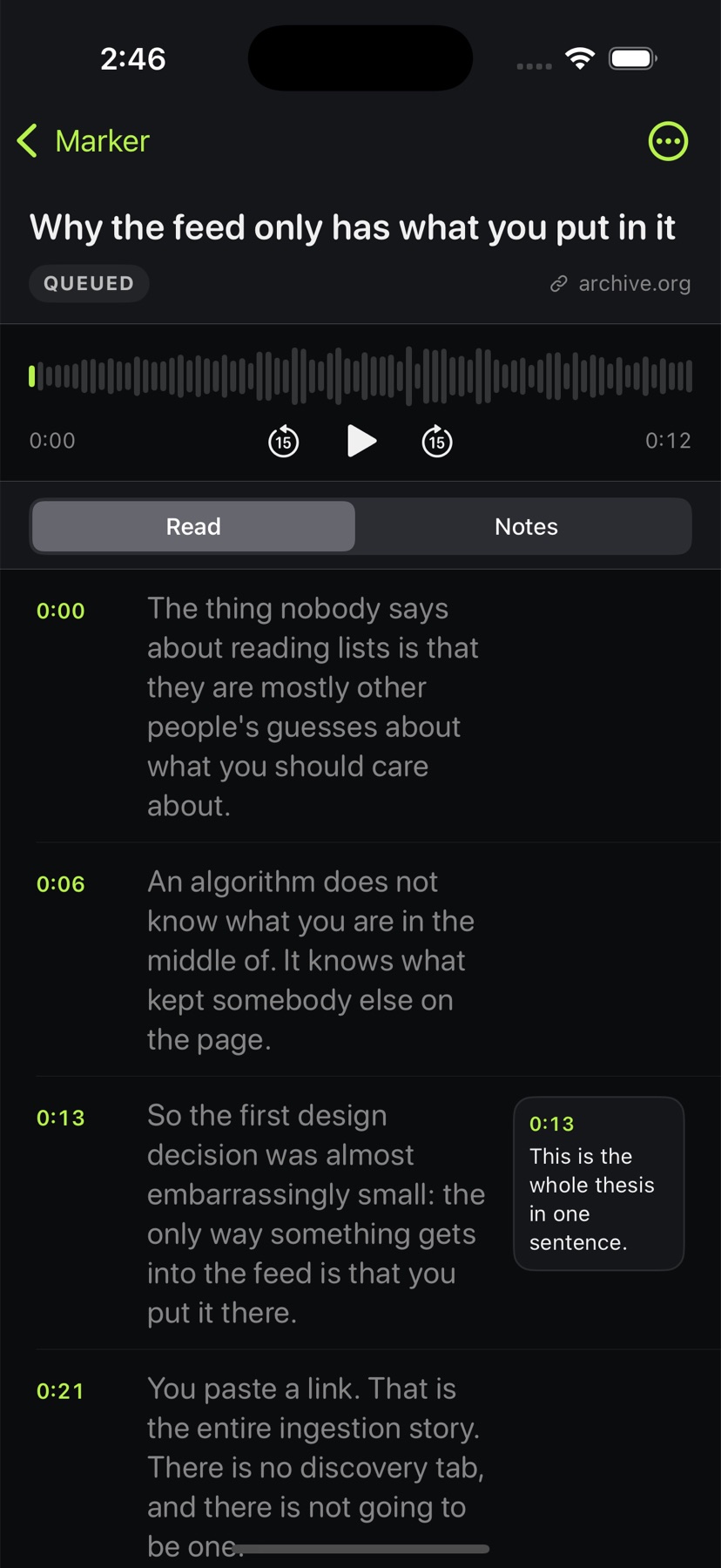
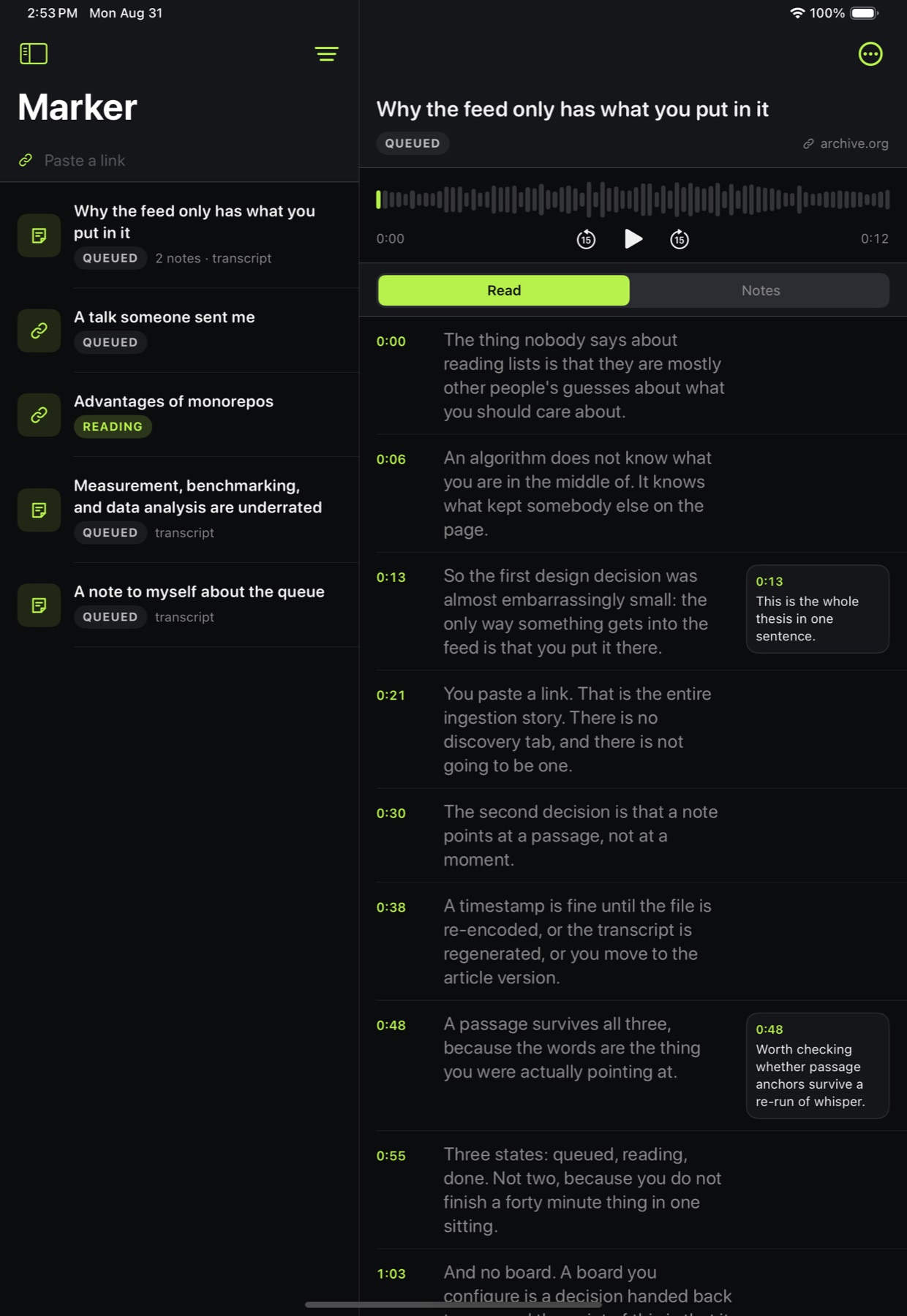
They are built and they work, but they are not signed for public distribution yet, so they are handed out directly rather than downloaded from here. The web app is the honest answer today, and it is the same queue.
What it will not do
Nothing here assumes a model, and nothing on the roadmap may. An annotator that is only good with a model attached is not an annotator, so the value without one has to be real first. Transcription is the single carve-out, and it runs during ingest, before an item exists.
Nothing is surfaced, ranked, or suggested. The list is what you put in it.
Nothing competes for your attention on behalf of something you already chose.
No followers, no likes, no counts. A link you share is a link, not a broadcast.
Your notes come out as Markdown or YAML from the item itself, any time, in one click.
That is the whole onboarding. There is nothing to configure, because there is nothing to decide.